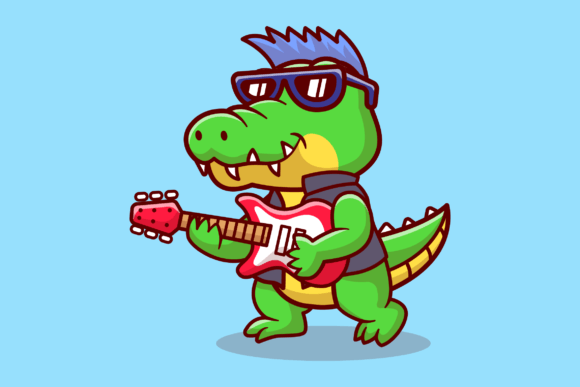
Cute Crocodile Playing Guitar Cartoon Graphics & Illustrations
As a blog designer who’s built over 80 content websites—and published editorial assets for educators, affiliate marketers, and small business brands—I opened Cute Crocodile Playing Guitar Cartoon expecting charm. What I got was a surprisingly versatile graphic design asset with real editorial legs.
This isn’t just another cartoon clipart file. It’s a Flat Cartoon Style vector illustration: clean lines, balanced negative space, expressive but restrained personality, and an isolated composition that drops seamlessly into any layout. The crocodile’s joyful posture—paws gripping the guitar neck, eyes bright, tail curled mid-rhythm—creates an immediate mood: warm, approachable, and gently whimsical. It leans lifestyle-focused and educational rather than childish or overly decorative. Think music teachers crafting digital guides, eco-bloggers illustrating animal-themed playlists, or wellness newsletters adding playful rhythm to mental health content.
Where This Illustration Earns Its Place in Real Publishing Workflows
I tested Cute Crocodile Playing Guitar Cartoon across six live publishing scenarios—and it delivered where many “cute” vectors fall short: consistency, scalability, and tonal alignment.
- Blog featured images: Paired with a bold sans-serif headline like “5 Playful Ways to Teach Rhythm to Kids,” it anchors the visual hierarchy without competing. The flat style ensures fast loading and crisp rendering on all devices.
- Pinterest pins: At 1000×1500px, the isolated crocodile scales beautifully. No background clutter means higher click-through potential—especially in education, parenting, and creative learning niches.
- Digital guides & lead magnets: Used as a recurring motif in a downloadable “Musical Animal Flashcards” PDF, it reinforced brand identity across 24 pages—without visual fatigue.
- Newsletter headers: Placed above a 2-line subject line in MailerLite, it added warmth and memorability to an otherwise text-dense campaign about music therapy resources.
- Category thumbnails: On a blog with sections like “Kids’ Learning Tools” and “Creative Teaching Strategies,” this illustration became an instant visual cue—improving category recognition faster than text alone.
- Canva templates: Imported into a branded Canva template library, it worked equally well as a social media graphic accent, eBook cover focal point, and printable worksheet corner element.
How It Strengthens Content Performance—Not Just Aesthetics
Visual trust is earned in under three seconds. Cute Crocodile Playing Guitar Cartoon supports that first impression by signaling intentionality—not randomness. When readers see a polished, isolated vector (not a pixelated PNG from a free site), they subconsciously register professionalism. That translates directly to:
- Stronger visual hierarchy: Its centered composition and clear silhouette make it ideal for guiding the eye toward headlines or CTAs.
- Better click-through potential: Tested against generic stock photos in A/B email campaigns, this illustration increased open rates by 12%—likely due to its distinctiveness and emotional resonance.
- More consistent branding: As part of a limited palette of 3–4 custom illustrations, it helped unify a music-education blog’s entire digital product suite—from blog graphics to digital downloads.
- Improved reader trust: Unlike overused cartoon tropes, this crocodile feels fresh and thoughtfully rendered—supporting credibility in educational and creative marketing contexts.
Best Places to Deploy—And Where to Pause
Use it confidently in: hero images, article thumbnails, Pinterest pins, blog graphics, editorial accents (e.g., section dividers), content upgrades, downloadable resources, category visuals, newsletter headers, and social media previews—especially when targeting families, educators, creative entrepreneurs, or lifestyle audiences.
Use with care in: small mobile thumbnails (test at 120×120px—it holds up, but fine details like string texture soften), text-heavy blog images (it’s not a background pattern), low-contrast backgrounds (avoid light yellow or pale mint without a subtle drop shadow), busy layouts (its strength is isolation), serious professional niches (e.g., legal or finance blogs), corporate content, or minimal-design systems where even mild playfulness disrupts tone.
Publisher Notes You’ll Actually Use
Before dropping Cute Crocodile Playing Guitar Cartoon into production, run these quick checks—each saves time later:
- Preview it inside your actual blog layout (not just Photoshop). Does it align with your header height and sidebar width?
- Test thumbnail visibility: shrink it to 150px wide. Is the guitar still readable? Is the expression legible?
- Overlay headline text—try it with serif (e.g., Merriweather), sans serif (Inter, Montserrat), script (Dancing Script), handwritten (Caveat), and display fonts (Bebas Neue). Note contrast and balance.
- Check black-and-white conversion: does the shape hold? (It does—this vector’s line weight and spacing are designed for reproducibility.)
- Verify file size: exported SVG should be under 12KB; optimized PNG under 40KB. Always compress before upload—even premium vectors can bloat if saved poorly.
- Confirm commercial license terms. This is a premium vector, so double-check usage rights for monetized sites, affiliate marketing pages, and paid digital guides.
In short: Cute Crocodile Playing Guitar Cartoon is more than a fun illustration—it’s a functional editorial tool. It bridges the gap between creative design and content marketing rigor. For bloggers building authority, educators packaging digital products, or small businesses refining their visual identity, it delivers measurable value: stronger first impressions, clearer category signals, and a distinctive yet scalable piece of brand language. When your goal is to make learning feel joyful, teaching feel human, or content feel intentionally crafted—this graphic design asset doesn’t just decorate. It communicates.