Dinosaurs Skeleton Silhouette Graphics & Illustrations
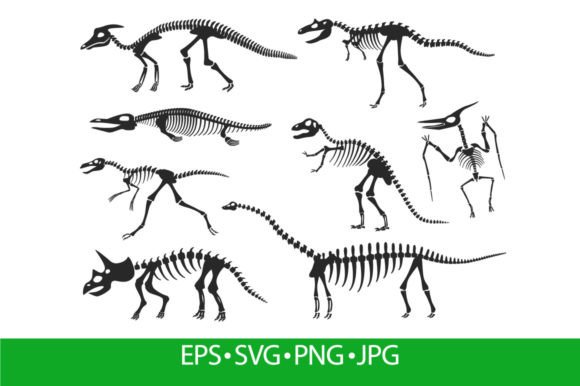
As a graphic designer who’s built brand identities for museums, launched Etsy shops for handmade science kits, and crafted seasonal packaging for indie toy makers, I opened Dinosaurs Skeleton Silhouette expecting either charming vintage charm or clinical textbook sterility. What I found was something more useful: a quietly confident, museum-grade vector set that lands right between educational clarity and creative versatility.
A First Impression That Sets the Tone
The moment you zoom in on the diplodocus, velociraptor, and pterodactyl bones, you notice how cleanly each silhouette breathes. These aren’t cartoonish clipart blobs — they’re precise, anatomically grounded illustrations with intentional negative space and balanced weight distribution. The line work feels archival, not algorithmic. That gives Dinosaurs Skeleton Silhouette an immediate mood: intelligent curiosity, gentle wonder, tactile authenticity. It doesn’t scream “kids’ party” — it whispers “curated learning,” “thoughtful gift shop,” or “local history exhibit.” That makes it ideal for clients who value substance over flash: small business branding for paleontology-themed stationery lines, boutique science subscription boxes, or educational printables for homeschool co-ops.
Where This Graphic Design Asset Earns Its Keep
In real client projects, Dinosaurs Skeleton Silhouette shines brightest where visual storytelling meets practical function:
- Product mockups and packaging design — Layered subtly behind hand-drawn typography on kraft paper labels for fossil-shaped chocolates or mineral bath salts. The white-isolated EPS/SVG format drops in cleanly without clipping issues.
- Printable design and wall art — Scaled large for museum-style posters or scaled down as delicate border elements in printable activity sheets. The vector scalability means no pixelation at any size.
- Cricut project and sublimation design — Clean cut lines mean minimal weeding time; the bone outlines hold up beautifully on ceramic mugs, tote bags, and cotton tees when heat-applied.
- Social media graphics and Canva templates — Used as hero visuals for Instagram carousels explaining prehistoric eras, or as consistent decorative accents across Pinterest pins for STEM educators.
- Brand identity systems — Not as a primary logo (too detailed), but as a supporting illustration system — think pattern repeats on tissue paper, icon variants for website navigation, or subtle watermark textures in email footers.
Where to Proceed With Intentional Restraint
This isn’t a one-size-fits-all graphic design asset. It performs poorly — or requires extra craft — in these contexts:
- Small-scale applications — Below 0.5 inches wide, the finer bone structures (especially the pterodactyl’s wing joints) blur into indistinct grey. Always test at final output size before locking in sticker or tag designs.
- Minimalist or corporate branding — Its inherent warmth and texture clashes with ultra-sleek tech or finance brands. It reads as *handmade business*, not boardroom-ready.
- Low-contrast layouts — Placing it over soft pastel gradients or busy photographic backgrounds risks losing definition. Stick to solid light or dark backgrounds for maximum clarity.
- Projects demanding strict visual hierarchy — Because each silhouette carries strong visual weight, it competes with bold headlines or dense body copy. Use it as a focal point — not background filler.
Design Judgment in Action: Real Client Scenarios
Last month, I used Dinosaurs Skeleton Silhouette for a local natural history center’s summer camp merch line. We placed the diplodocus outline — enlarged, reversed to white on navy fabric — across the chest of organic cotton t-shirts. It felt authoritative yet approachable. Parents responded to its quiet credibility; kids loved spotting the details. Contrast that with an earlier attempt for a fintech startup’s “innovation summit” — the same silhouette looked oddly solemn and off-brand beside sleek sans-serif type. Context is everything.
For an Etsy seller launching dinosaur-themed printable planners, I layered the velociraptor bones as faint watermark textures behind weekly layout grids. The SVG editability let me adjust stroke weight and opacity until it supported — never distracted from — the functional design. That flexibility is why this belongs in your commercial design toolkit, not just your free clipart folder.
Practical Designer Notes Before You Commit
Before dropping Dinosaurs Skeleton Silhouette into a client file, run these checks:
- Test it in pure black and white — does the contrast hold? (It does — the vectors are clean enough for screen printing.)
- Preview on both light and dark mockups — especially if planning web design or social media graphics.
- Zoom to 400% and 25% — verify legibility at intended use sizes.
- Drop it onto actual product mockups (mugs, stickers, notebooks) — vector assets can look deceptively sharp on screen but lose nuance in physical reproduction.
- Confirm commercial license terms — this is a commercial design asset, but always verify permitted usage scope (e.g., unlimited end products vs. capped units).
- Compare with your type palette: it pairs best with sturdy serifs (like Playfair Display), friendly sans-serifs (Poppins), or restrained display fonts — avoid overly decorative script or handwritten fonts that fight its structural clarity.
Why This Belongs in Your Creative Marketplace Toolkit
Dinosaurs Skeleton Silhouette isn’t flashy — and that’s its strength. In a landscape saturated with overdesigned, trend-chasing assets, it offers timeless utility. It builds trust through precision, supports storytelling through subtlety, and scales gracefully across digital product, printable design, and physical merchandise. Whether you’re designing for a science educator’s Canva template shop, a Cricut crafter’s Etsy store, or a local museum’s rebrand — this is the kind of illustration that doesn’t shout, but stays memorable. It’s not just another clipart download. It’s a thoughtful, production-ready piece of visual infrastructure.