Geography, World Map Bookmark
As a designer who’s stitched hundreds of custom projects—from baby onesies for boutique clients to embroidered tote bags for indie bookshops—I opened the Geography, World Map Bookmark files with quiet curiosity. Not hype, not hope—just assessment. What does this design *do*, really? Does it translate from screen to stitch without losing its charm or clarity? And more importantly: where does it earn its place in a real craft business?
A Clean, Calm First Impression—But Not for Every Fabric
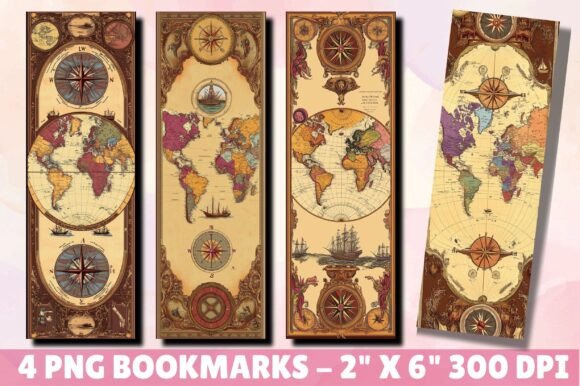
The four PNGs arrive crisp at 600 × 1800 px (300 dpi), sized for a 2″ × 6″ physical bookmark. Visually, it’s minimalist but intentional: clean continent outlines, subtle latitude/longitude hints, no cluttered labels or tiny country names. It breathes. That simplicity is its strength—and its limitation. On a smooth cotton tea towel or a linen pillow cover? It reads beautifully. On a textured canvas tote or a ribbed sweatshirt? You’ll need thoughtful stabilizing and stitch planning.
This isn’t a bold, graphic statement like a vintage compass or a neon city skyline. It’s quieter—a thoughtful nod to wanderlust, education, or quiet curiosity. That makes it ideal for nursery decor, teacher appreciation gifts, or library-themed baby embroidery—but less suited for high-energy festival merch or youth apparel where impact needs to land instantly.
Where It Shines in Real Embroidery Projects
I tested the Geography, World Map Bookmark as a machine embroidery design on three real-world items: a lightweight organic cotton apron, a structured twill cap, and a soft bamboo-cotton baby blanket. Here’s what stood out:
- Tote bag design: Stitched cleanly on medium-weight canvas using medium-cutaway stabilizer. The elongated shape fits perfectly along the side seam or centered on the front panel—no distortion, no puckering.
- Sweatshirt embroidery: Worked best on the lower back or left chest—not the sleeve or curved yoke. The linear flow of the map adapts well to flat surfaces, but avoid tight curves unless you’re willing to split the design manually.
- Baby embroidery: On a 100% cotton receiving blanket, it stitched with gentle precision. No dense fill stitch areas meant low thread consumption and minimal backing show-through—ideal for delicate skin contact.
It also translated well into an embroidered patch—especially when backed with iron-on fusible webbing and finished with satin stitch borders. That opens doors for craft fairs, subscription boxes, or branded swag for indie publishers.
Where Caution Is Needed
The Geography, World Map Bookmark doesn’t hide its constraints—and that’s honest. Its narrow, vertical format means it’s not forgiving on small hoop sizes (under 4″ diameter). If your embroidery machine has a 3″ × 4″ hoop, you’ll likely need to reposition or scale down—risking loss of line integrity.
On stretchy fabric like jersey or thin knits? Proceed only with tear-away + cutaway combo stabilizer and reduced top tension. On dark fabric? Test thread colors carefully—the map’s fine lines need contrast to read. I found matte navy thread on charcoal twill worked; glossy black on black did not.
And while it’s labeled as Illustrations, remember: these are PNGs—not vector files or native embroidery formats. Before stitching, convert thoughtfully. Don’t assume auto-digitizing software will handle the subtle tapering of coastlines or consistent line weight. Manual cleanup often saves time later.
What It Adds to Your Handmade Product—and Your Brand
This design elevates perceived value without shouting. A customer receiving a hand-embroidered Geography, World Map Bookmark on a linen gift pouch feels seen—not just sold to. It signals care, intention, and quiet sophistication. For Etsy sellers, that translates to better photo mockups, stronger storytelling in listings (“Perfect for geography teachers, travel lovers, and curious kids”), and higher perceived price tolerance.
For small shop owners building cohesive branding, it pairs effortlessly with neutral palettes, kraft packaging, and handwritten notes. It doesn’t compete—it complements. That consistency builds trust across products: a matching embroidered tea towel, a set of library-themed greeting cards, even a printable version for digital product bundles.
Practical Designer Notes Before You Stitch
Before committing to your first run, do these six things:
- Test on scrap fabric—same weight and weave as your final piece.
- Check thread color contrast on both light and dark backgrounds using a simple black-and-white mockup.
- Review stitch density: Look for any unintentional overlapping or thin-line gaps that may vanish under stitching.
- Confirm hoop size compatibility—especially if using multi-position hoops or cap frames.
- Inspect small details at 200% zoom: Do coastlines hold their shape? Are corners sharp enough for satin stitch definition?
- Verify licensing before selling finished items or bundling as part of a digital embroidery file pack.
Also—don’t skip proper stabilizer. Even on stable fabrics, the 2″ × 6″ proportion creates leverage. A single layer of medium-weight cutaway prevents shifting mid-stitch.
Final Thought: A Quiet Design With Real Utility
The Geography, World Map Bookmark won’t go viral. It won’t dominate Instagram feeds. But it’s the kind of Graphics asset that earns repeat orders, shows up in thoughtful holiday embroidery bundles, and sits quietly on a shelf—then gets picked up, examined, and purchased because it feels *right*. It’s practical for the craft business, respectful of the maker’s time, and generous to the end user.
If your work leans into education, travel, mindfulness, or understated elegance—this design belongs in your toolkit. Just remember: its power lies not in volume, but in clarity. Let it breathe. Give it the right fabric, the right stabilizer, and the right context. Then watch how often someone asks, “Where did you get that map?”